
Hello!
Tom here. I hope you’re all surviving this heat! It really is scorching. As I’m writing this, I’m sitting in our newly spruced-up warehouse in trendy Norf London. Fonz is next to me editing photographs while Jay is charging around doing about six jobs at once. Literally as I started writing this he announced he’d lost his car keys…
…and about thirty seconds later he’d found them.
Crisis over.
To be honest, from Jay’s point of view it probably looks like I’m sitting comfortably on my laptop while he’s doing all the work. Luckily he hasn’t noticed yet, so let’s keep it that way…
Anyway, enough about us!
With summer finally here, I thought we’d show you a couple of our latest arrivals that seem rather fitting for the season. One is all about flowers, the other is all about bees. Mother Nature would approve.
Flowers That Never Wilt


One of our latest acquisitions is a remarkable collection of nineteenth-century didactic botanical flower models. That’s a rather grand way of saying they were made to teach botany—but trust me, they’re far more beautiful than that description suggests.
The first thing you notice is their size. They’re huge!
Of course, that wasn’t because Victorian scientists wanted dramatic centrepieces. Before projectors, PowerPoint and giant television screens, lecturers had to teach packed halls full of students. If you wanted the people in the back row to understand the anatomy of a flower, you simply made the flower much bigger.
Simple.
These extraordinary models were produced by Robert Brendel and later his son Reinhold, whose workshops became famous throughout Europe for producing the finest botanical teaching models of their day.
Working alongside some of the leading botanists of the nineteenth century, the Brendels created enlarged flowers that could be taken apart piece by piece, allowing students to study every minute detail. By the end of the century, their models had won awards across Europe and America and were being used by universities and museums around the world.
Today they’re appreciated just as much for their sculptural beauty as for their scientific importance. They sit somewhere between science, art and design… and we absolutely love them.
A Swarm of British Silver

Talking of flowers…
We recently acquired something rather charming: a complete swarm of eight silver-plated honey bee preserve pots by Mappin & Webb and Garrard & Co. Jay and I have been finding them individually over the past year or so. Busy bees!
There are few objects that make people smile quite as quickly as these.
Each bee has a coloured glass abdomen which forms the preserve jar itself, while its beautifully chased wings lift to reveal the honey inside. Tucked neatly between the wings sits its own little spoon.
They’re wonderfully engineered.
What I particularly like is that they aren’t simply novelty objects. Someone sat down over a hundred years ago and thought, “How do we turn a bee into something genuinely useful?” The result is brilliant. The body becomes the jar, the wings become the lid and suddenly breakfast becomes just a little bit more entertaining.
Most examples survive individually, so to collect eight together is incredibly unusual. Displayed as a group they almost become a sculpture before anyone has even reached for the toast.
They remind us that good design doesn’t always have to be serious. Sometimes it’s simply meant to make you smile.
F.F.F. – Fonz’ Favourite Five
Before we go, it’s time for another edition of F.F.F. – Fonz’ Favourite Five!
This newsletter Fonz picks the five pieces he’d most like to take home himself… assuming Jay doesn’t sell them first.
His tastes are wonderfully eclectic, and gets the pressure off me and this month he’s excelled himself.
• Javanese Throne Chairs – Farmleigh Collection, Guinness family.
A Pair of Carved Hardwood Throne Chairs, Java, c.1900


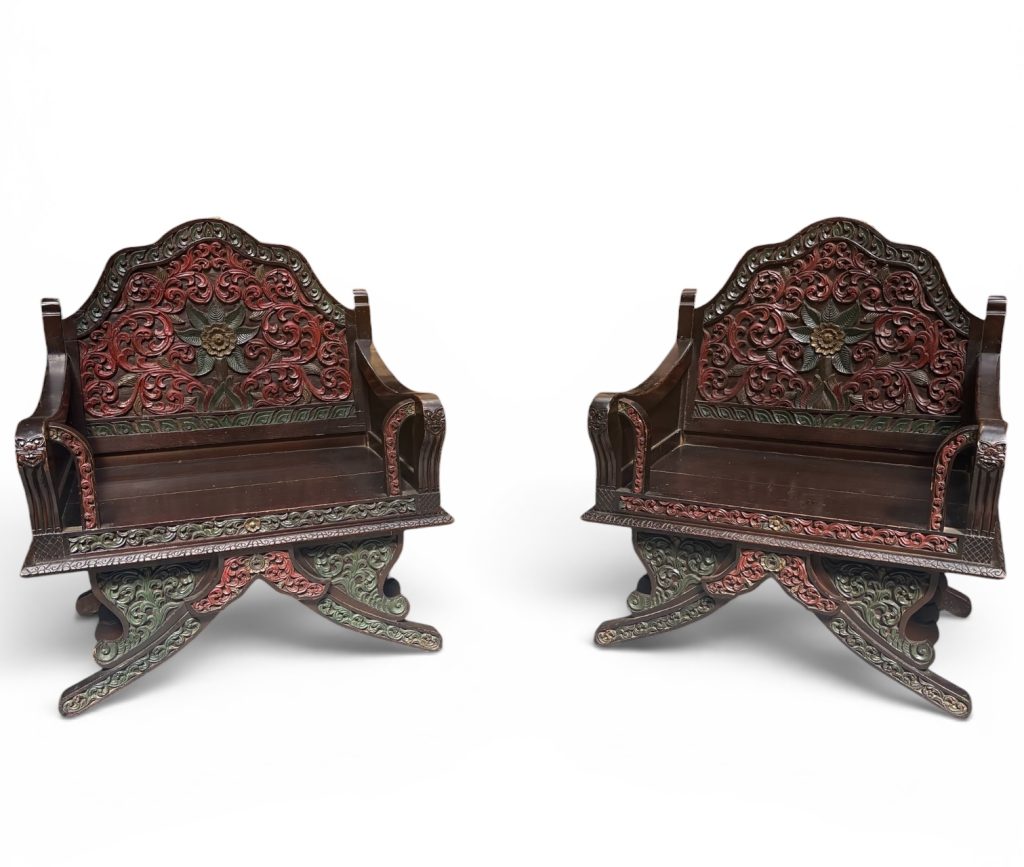


When Fonz first saw these chairs, he simply looked at Jay and said, “They’re staying!”
Sadly for him, they aren’t.
Hand-carved in Java around 1900, these magnificent hardwood throne chairs are a wonderful blend of indigenous Indonesian craftsmanship with Indian and European influences. Every surface is alive with deeply carved scrolling foliage and flowers, while their distinctive ‘X’-frame supports give them a wonderfully sculptural quality.
What makes them even more special is their provenance. These chairs once formed part of the celebrated Farmleigh Collection of the Guinness family. Purchased by the 1st Earl of Iveagh in 1873, Farmleigh became one of Ireland’s great country houses, renowned for its exceptional collections of furniture, paintings and decorative arts assembled over generations.
It’s always exciting when a piece comes with a story, and these chairs have certainly earned theirs.
Measuring 76 cm wide, 66 cm deep and 86 cm high, they’re surprisingly comfortable and would make an extraordinary statement in both a traditional and a contemporary interior.
• Edo period Samurai Helmet – ex Sir Frank Bowden collection.
An Extraordinary Samurai Helmet, Japan, Edo Period, c.1800


Now this is one of those objects that simply stops you in your tracks.
When Fonz first spotted this Japanese samurai helmet, he wandered over for a closer look… and then didn’t wander away for quite some time.
Dating from around 1800, this spectacular helmet was never intended to blend into the crowd. Quite the opposite. During Japan’s Edo period, powerful feudal lords would travel in magnificent processions, and helmets like this were designed to announce status, prestige and authority long before their wearer had even arrived.
The sweeping, court-cap silhouette gives it an unmistakable profile, while the gilded crescent crest and beautifully laced neck guard transform it into something that’s as much sculpture as armour. It perfectly demonstrates the extraordinary craftsmanship for which Japanese armourers became renowned.
What makes this example even more exciting is its provenance. It comes from the collection of Sir Frank Bowden, whose renowned collection of Japanese arms was sold at Christie’s in London in 1983. Bowden was not simply a collector—he was one of Britain’s leading authorities on Japanese martial culture, serving as President of the British Kendo Society and later receiving the Order of the Rising Sun from the Japanese government for promoting Anglo-Japanese understanding.
It’s not often that history, craftsmanship and provenance come together quite so beautifully.
• Chinoiserie Strong Box – from Kinsham Court, home of the Arkwright family.
Kinsham Court Chinoiserie Strong Box


Fonz’s third choice is a wonderfully atmospheric Chinoiserie strong box.
At first glance it’s simply a decorative piece of furniture, but then you discover where it’s spent much of its life.
It came from Kinsham Court, the Herefordshire home of the Arkwright family. Jay got me to do a bit of research on it and I managed to find a photo of it in situ! There it was, quietly sitting beneath a portrait of one of the family’s beloved pointers, exactly where it had lived for generations.
Seeing it in its home somehow changes everything.
You can almost imagine generations of the family walking past it every day without giving it a second thought.
It’s exactly the sort of object we love—part furniture, part work of art and part storyteller.
• The Four Very Well-Dressed Rams – gloriously eccentric and unforgettable.
Four-fold Screen 2nd Half 20th Century


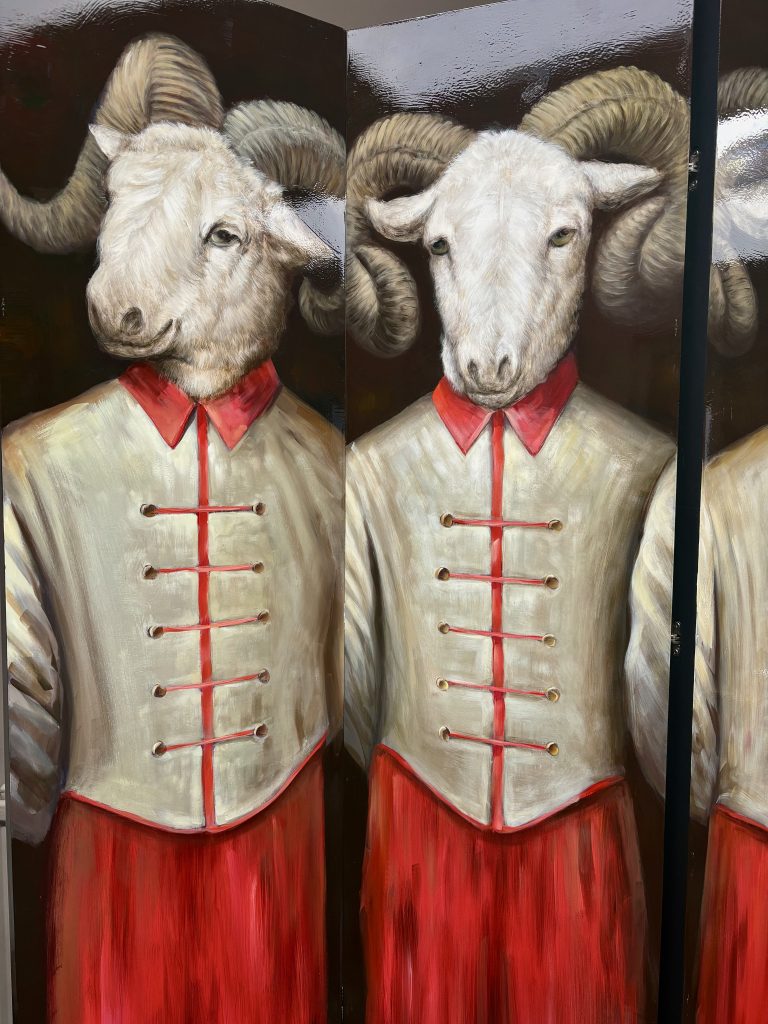
Number four had us all smiling.
When Fonz first saw this extraordinary four-fold screen, he couldn’t stop laughing.
Four rather distinguished-looking rams, dressed in immaculate red uniforms, staring straight back at you.
It’s gloriously eccentric.
Standing over two metres high and painted on both sides, it has all the confidence of a theatrical set. Whether it was intended as a room divider, a conversation piece or simply a work of art is anyone’s guess…
…but it certainly succeeds on all three counts. It’s a bit of a mystery as to where it comes from and who made it. Jay reckons it’s French latter part of the 20th Century.
•Do you dig my Lion – discovered in situ on the Antinori estate in Italy before being excavated and brought back to London.
The Antinori Heraldic Lion, Perugia, c.1870–1900


Every now and then, Jay comes back from a buying trip with a story that’s almost as good as the object itself.
This magnificent terracotta lion is one of those stories.
When Jay found him in Italy, he wasn’t sitting proudly on a plinth waiting to be admired.
He was still exactly where he’d stood for generations.
Half buried beneath the woodland floor on the old Antinori estate, surrounded by trees and slowly being reclaimed by nature. Before he could even begin the journey back to London, the lion literally had to be dug out of the earth.
Looking at him there, you can’t help but wonder how many people had walked past him over the decades without realising what lay beneath the undergrowth.
Resting beneath his paw is the heraldic shield of the Antinori family of Perugia, one of Italy’s great aristocratic dynasties. Research suggests he once stood proudly at one of the family’s villas, welcoming visitors as a symbol of strength and protection.
When Fonz first saw him in the warehouse, he didn’t notice the dirt or the years of weathering. He saw the magnificent modelling, the flowing mane and the wonderfully calm expression.
His verdict was immediate.
“Just imagine what he’ll look like when we’re finished.”
That’s one of the things we love most about this business.
Sometimes the greatest treasures aren’t sitting in auction rooms.
Sometimes they’re quietly waiting in an Italian woodland…
…until somebody comes along and gives them another chance to roar.
Whether your taste runs to samurai helmets, aristocratic lions, Javanese throne chairs, whimsical bees or four impeccably dressed rams, we hope there has been something to catch your eye this month.
As always, if you’d like any additional photographs, dimensions or condition reports, we’d be delighted to hear from you.
Until next time…
Stay cool, stay hydrated, and enjoy the rest of the summer.
Tom, Jay & Fonz