
Shop
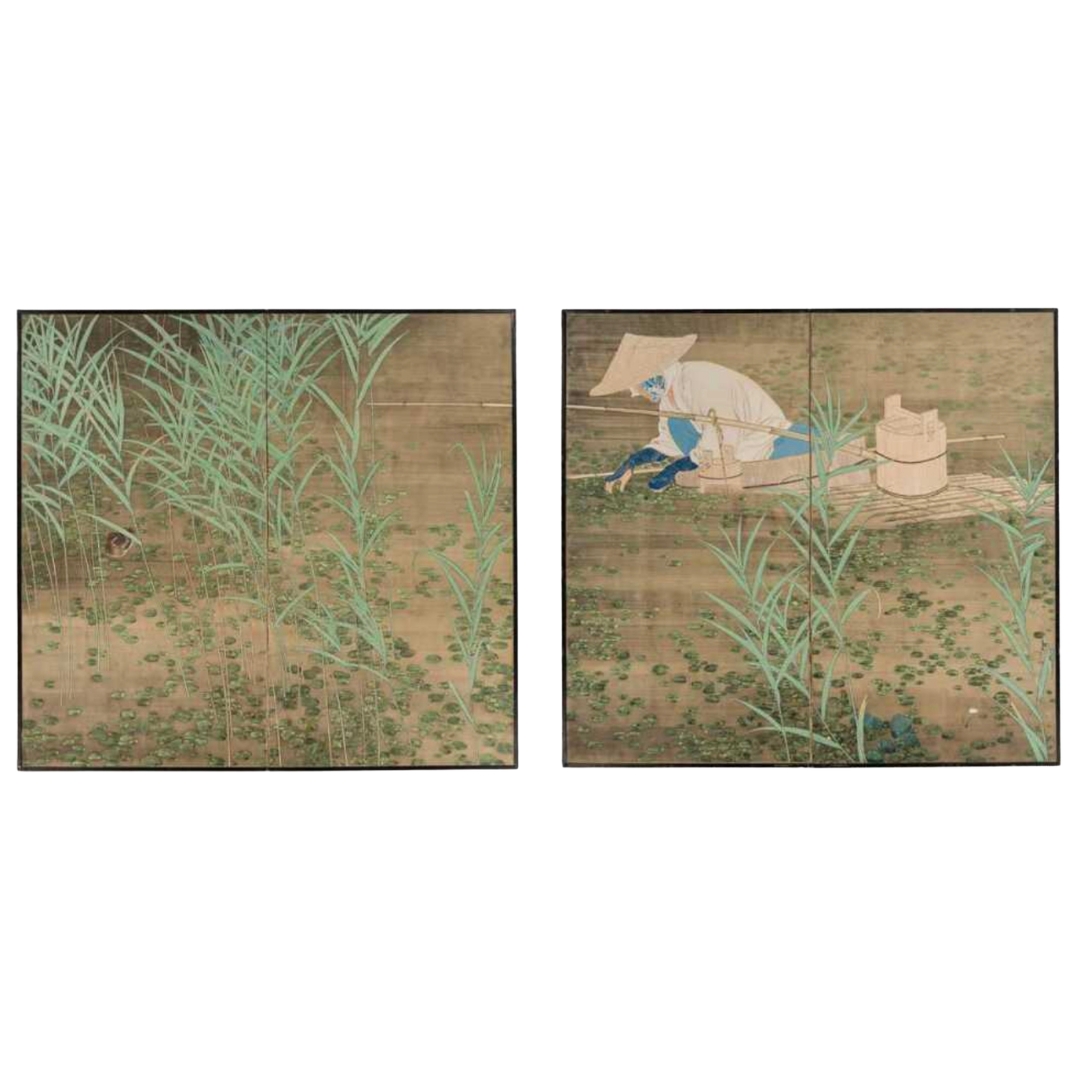
Hatta Koyo: Picking Junsai By Hatta Koyo (1882-1944), signed Koyo with seal Seisui Japan, circa 1910
Hatta Koyo: Picking Junsai By Hatta Koyo (1882-1944), signed Koyo with seal Seisui Japan, circa 1910
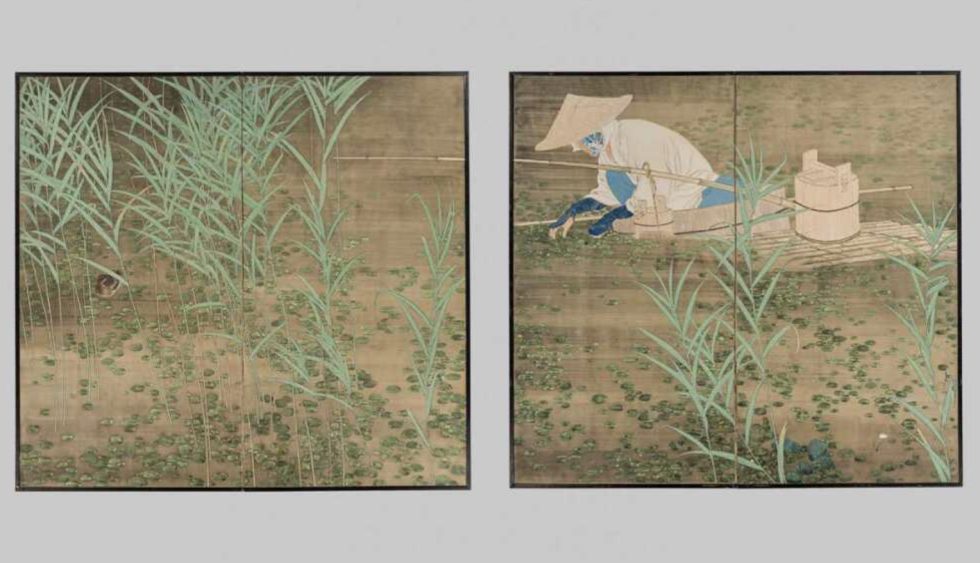
Ink and watercolors on paper. Each mounted on a pair of two wood panels. Finely painted to depict a Tsumiko (junsai picker) sitting inside a flat-bottomed tub as she reaches into the water with one hand, feeling for Junsai buds, and pinches them off the stem, collecting it in her bucket. A bamboo raft to the side with another bucket resting on the top. The pristine water is painted with lily pads rendered in an impressionist manner, a small duck preens itself, partially hidden by tall reeds.
Hatta Koyo (1882-1944) was a Japanese painter active from the Meiji to early Showa periods. He used the art names Seisui and Seiro and initially studied under Nakajima Yusho. At the very young age of 14, he studied under Takeuchi Seiho, mastering the Shijo school. He was selected for the 1st Bunten Exhibition in 1907, and was also selected for the Teiten Exhibition in 1919. He was nominated for the Teiten in 1929. He further studied with Nishimura Goun and Nishiyama Suisho, and was known as one of the ‘Three gifted students’.
The exchange between Impressionism and Japanese art was a profound and influential dialogue. Impressionist artists like Claude Monet were deeply inspired by Japanese ukiyo-e woodblock prints, particularly those by Hokusai and Hiroshige. Monet collected hundreds of these prints and adopted their esthetic elements—flattened perspective, bold colors, and asymmetrical composition—into his own work. This influence is especially clear in his iconic water lily series and Japanese bridge scenes, which reflect the stylized yet naturalistic qualities of Japanese landscapes. Conversely, Monet and the broader Impressionist movement left their mark on Japanese artists during the late 19th and early 20th centuries. The yōga (Western-style) movement embraced elements of Impressionism, as seen in Koyo’s depiction of junsai leaves, which echoes the loose, luminous treatment of Monet’s water lilies. This mutual influence highlights a rich cross-cultural artistic exchange that reshaped visual language in both Europe and Japan.
I love this piece because it instantly makes me feel more calm. If the black forest bears are not free for a hug at the warehouse, I’ll usually go and imagine that I’m fishing for junsai leaves in Japan instead!
Inscriptions: To the bottom left, signed Koyo 高容 with seal Seisui 青翠.
Provenance: From the private estate of Dr. Glenn and Carol Webb. Dr. Glenn Webb (1935-2024) was a noted scholar of Japanese art history, culture, and Buddhism. Dr. Webb was ordained in the Rinzai Zen priesthood and became an accredited instructor of Urasenke chanoyu. In 2011, Webb was bestowed the Order of the Rising Sun by His Imperial Majesty the Emperor Akihito in honor of his contributions to the field of Japanese studies, his accomplishments as a tea ceremony master, and his work in strengthening ties between the U.S. and Japan.
SIZE: H 186 cm x W 171.5 cm x D 3cm (each)
£32,000.00