
Shop




An Important Egyptian Revival Cat Stool, Cairo, circa 1884, Giuseppe Parvis
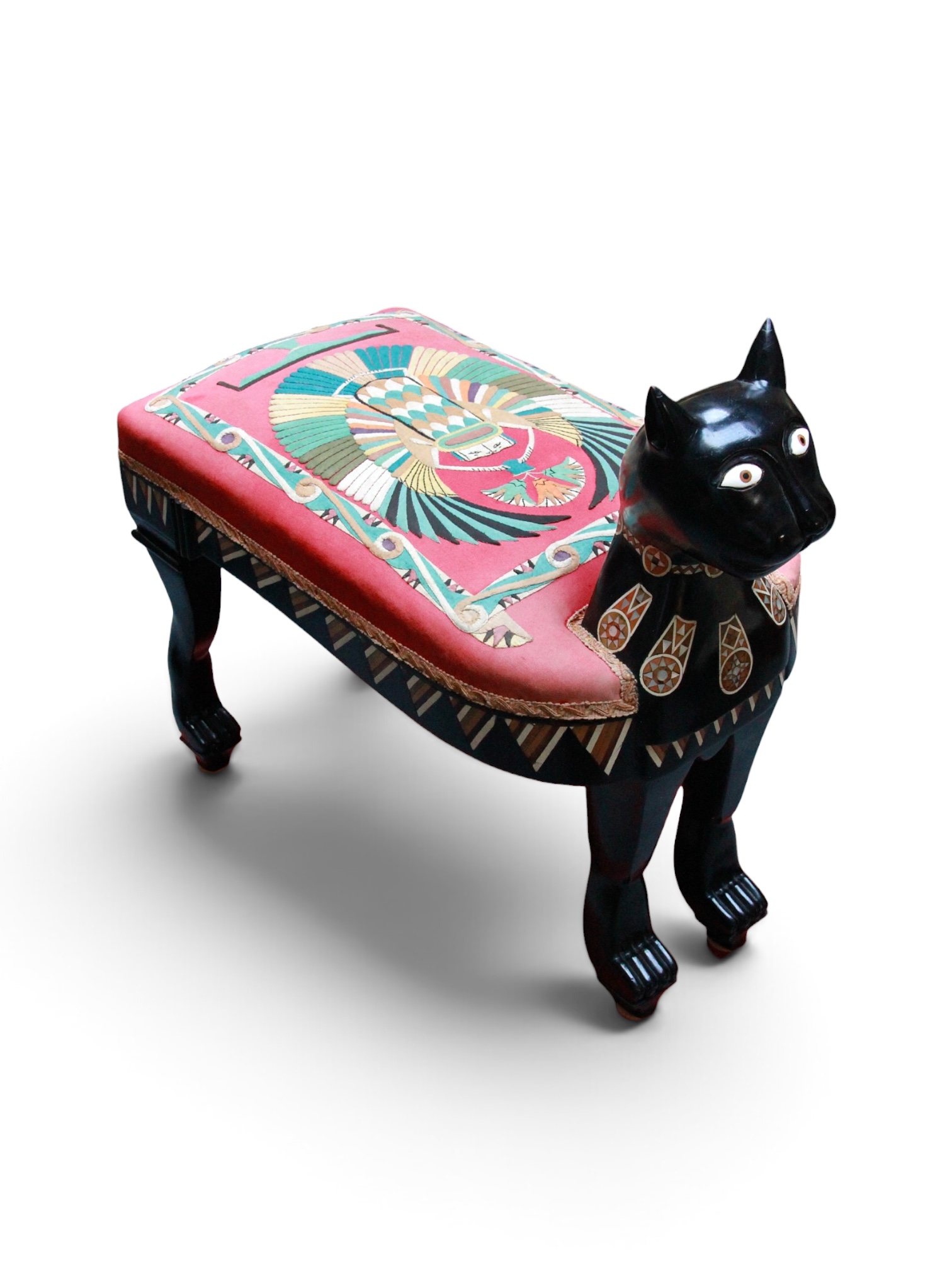
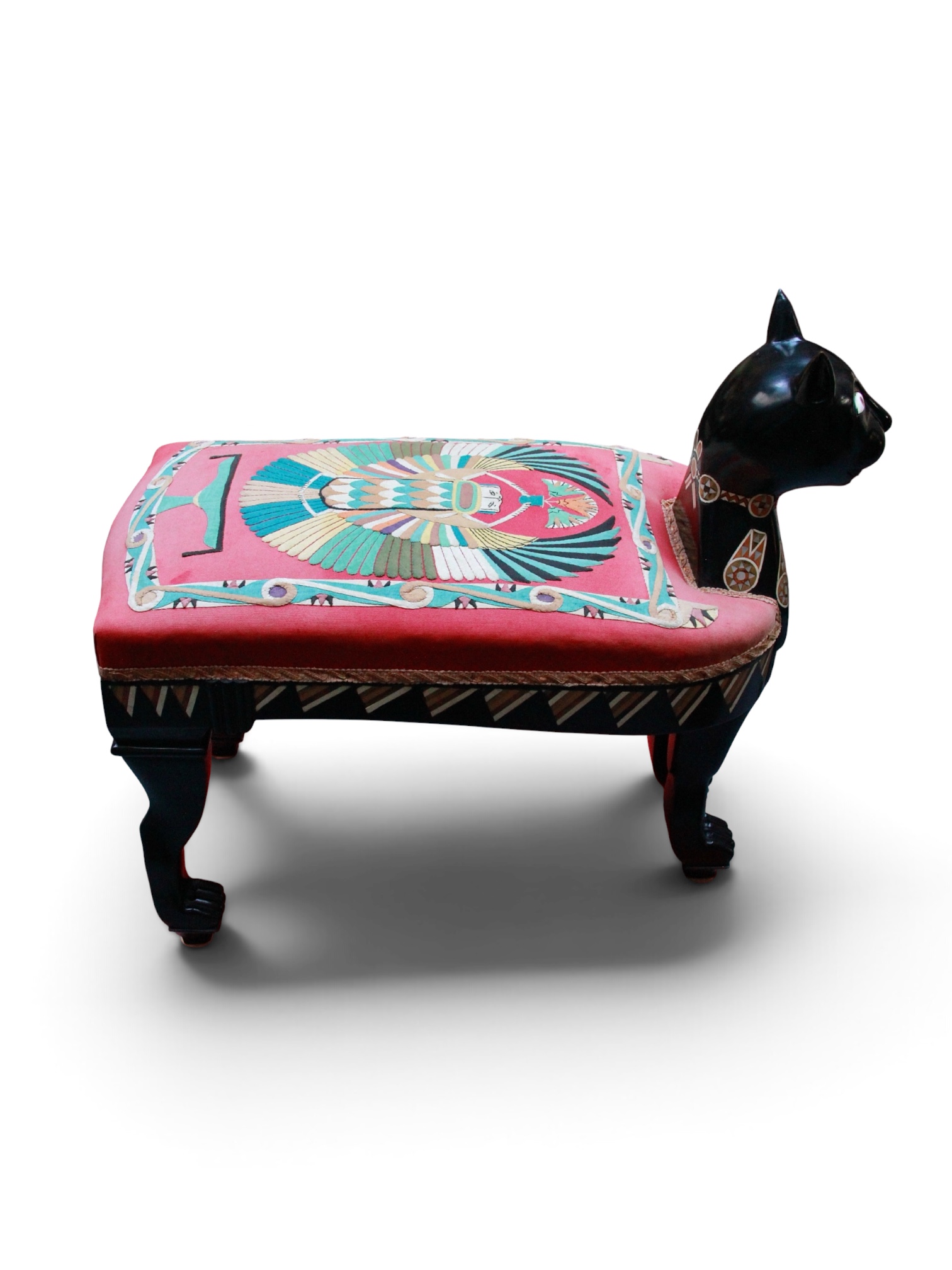
A highly unusual carved, painted and decorated neo-Egyptian cat stool, attributed to Giuseppe Parvis (1831–1909), Cairo, circa 1884.
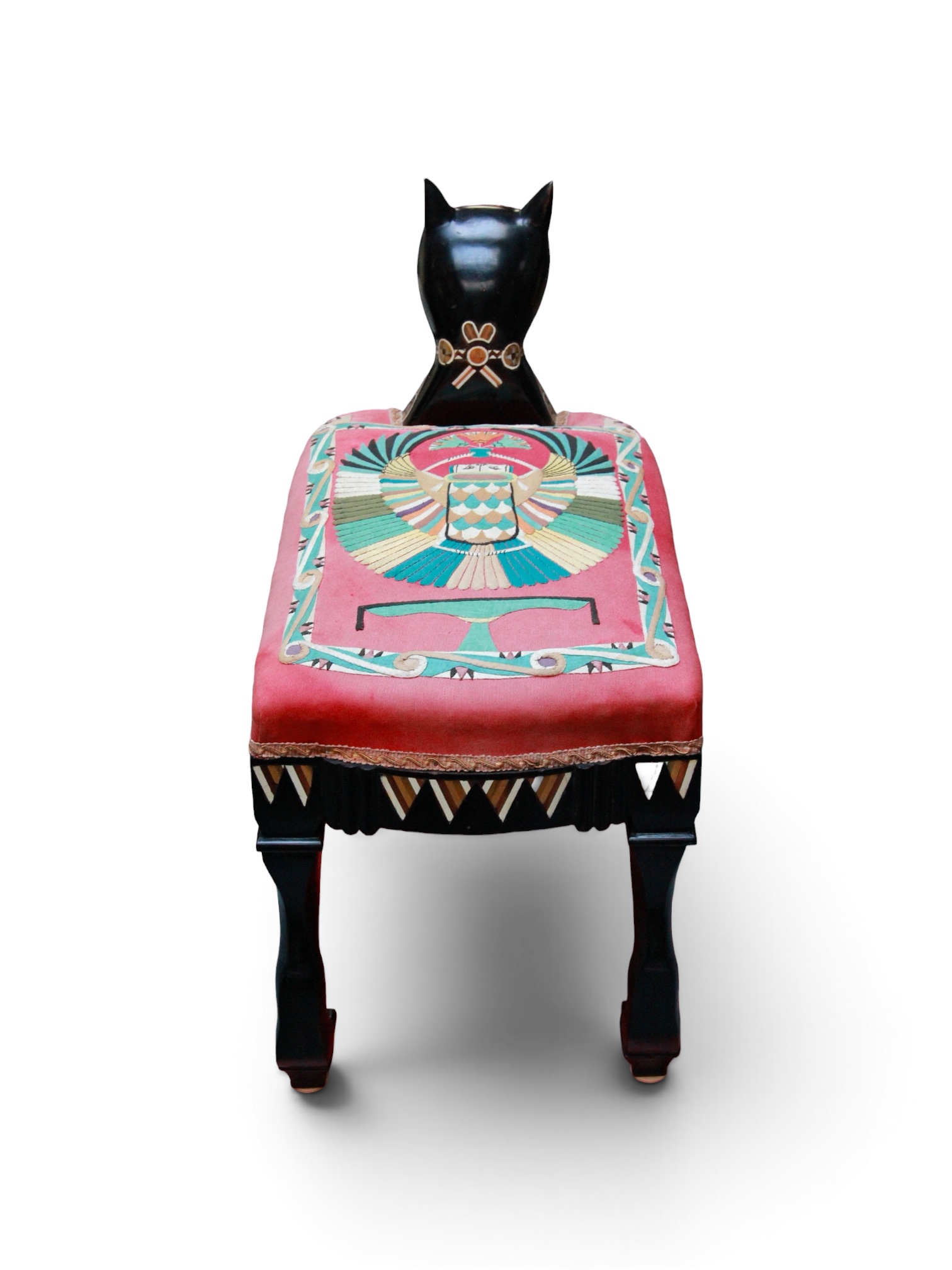
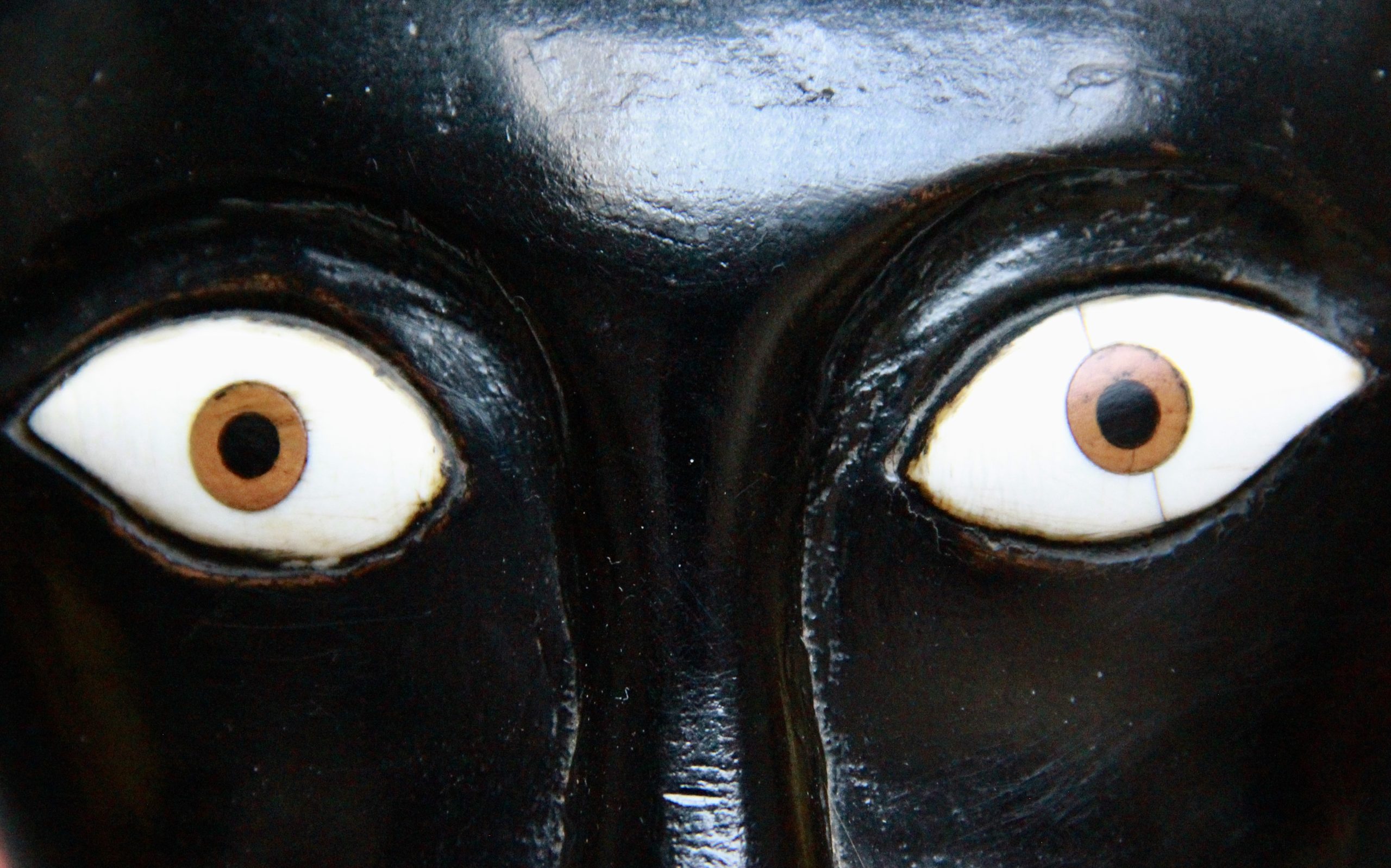
The stool is conceived as a stylised sacred cat, its boldly projecting head with upright ears and exceptionally striking inlaid eyes, the black-painted body enriched with finely executed geometric and Egyptianising ornament. The animal wears a broad ceremonial collar composed of pendant motifs, while its straight forelegs terminate in carefully carved paws.
The generously upholstered rectangular seat is covered with a vivid Egyptian Revival textile centred by a large winged pharaonic motif, surrounded by stylised geometric and lotus-derived ornament in pink, turquoise, cream and green. The textile and decoration of the carved base form an unusually coherent decorative scheme, giving the piece the appearance of having been conceived as an integrated Egyptian Revival design.
The attribution is strongly supported by a closely related neo-Egyptian zoomorphic pouf by Giuseppe Parvis, dated 1884, preserved in the Museo Stibbert, Florence. The Stibbert example employs the same fundamental conception: an upholstered rectangular seat supported upon an elongated animal form, with the animal’s head and forelegs projecting prominently from the front.
The Stibbert pouf is published in Giuseppe Parvis: Ebanista e designer tra Egitto ed Europa nel secondo Ottocento, edited by Manfredi Lapi Gatteschi, Tav. 76, where it is specifically catalogued:
“Giuseppe Parvis, Pouf in stile neo-egizio, 1884. Museo Stibbert, Firenze.”
Giuseppe Parvis, an Italian cabinetmaker established in Cairo, became one of the most celebrated furniture designers working in Egypt during the later nineteenth century. His furniture combined European cabinetmaking with Islamic and ancient Egyptian sources and was produced for an international clientele fascinated by Egypt and the emerging taste for archaeological revival styles.
The present cat stool belongs particularly closely to Parvis’s neo-Egyptian production of the 1880s, and the documented 1884 Stibbert pouf provides an important contemporary parallel for its unusual zoomorphic construction.
Cairo, circa 1884.
Attributed to Giuseppe Parvis.
Carved and painted wood with applied/inlaid decoration and upholstered seat.
Literature
Manfredi Lapi Gatteschi (ed.), Giuseppe Parvis: Ebanista e designer tra Egitto ed Europa nel secondo Ottocento, Tav. 76, illustrating a Giuseppe Parvis neo-Egyptian pouf dated 1884, Museo Stibbert, Florence.
H 66 x W 36 x D 76
£12,000.00