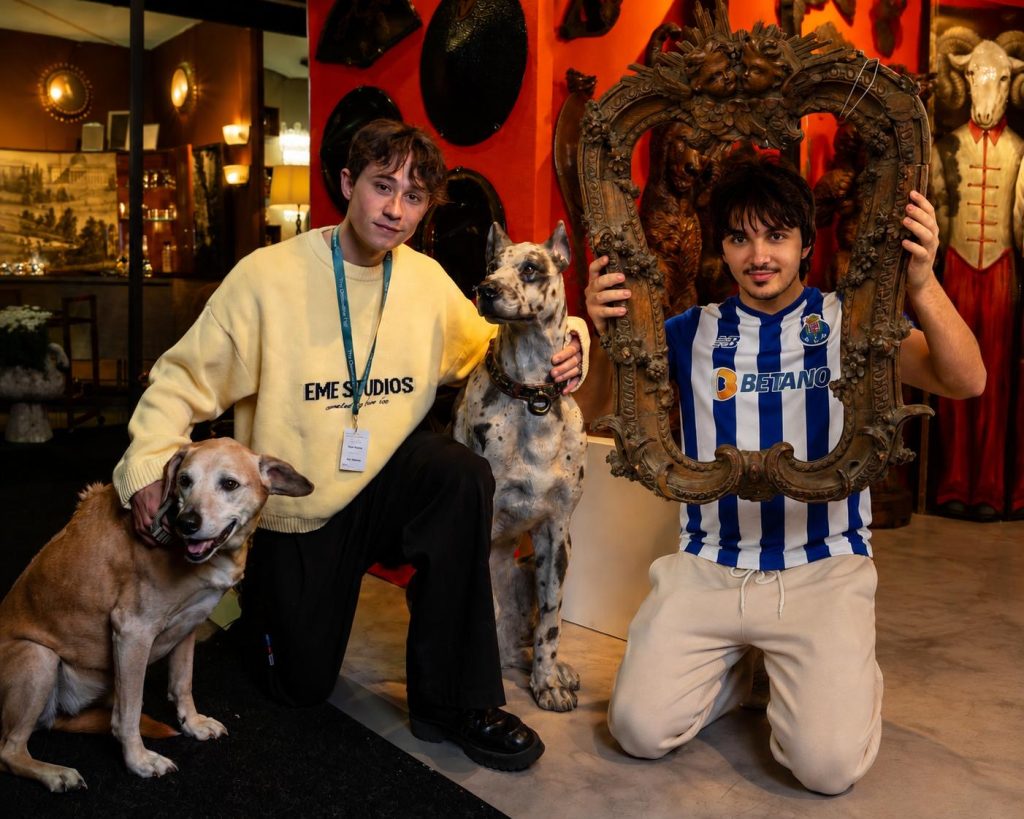
Dear Tom and Fonz,
For those of you who don’t know them, Tom and Fonz are my godsons — although that doesn’t quite explain it. Somewhere along the way I seem to have adopted them, or perhaps they adopted me. I’m never entirely sure which.
They’ve become part of the world of Jay Arenski: the buying, the looking, the schlepping, the arguing, the excitement when we find something extraordinary and the occasional moment when they look at me as though I’ve completely lost my mind.
And then there is my favourite part — when one of them asks a really good question. It’s never the question I expect, and quite often it’s one I don’t actually know the answer to. Which is perfect. Because then I get to learn. They make me look harder, think differently, and see things I might have missed. It’s one of the great pleasures of having them around: they keep me curious.
So I thought I’d write this newsletter as a letter to them.
You’re very welcome to listen in.
There have been two interesting articles recently about Old Masters. The Financial Times, on 5 March 2026, talked about the “new rules” of collecting them. Then, on 18 August 2026, the Telegraph announced that, after years in the doldrums, Old Masters were wanted again.
I’m not sure they ever went away.
Perhaps what went away was the idea of how we were supposed to live with them.
For years we were taught to put things into boxes. An Old Master belonged with antique furniture. A piece of eighteenth-century sculpture belonged in an eighteenth-century room. Modern art went with modern furniture. Everything had its place, its date and its label.
I’ve never really understood that.
Perhaps it is fashion. In fact, of course it is. Taste moves in cycles and at the moment the rules are changing again. Old Masters are being looked at differently because people are putting them in rooms differently.
But I’ve always found the rules rather constraining.
I never specialised. I couldn’t. I always thought specialisation meant deciding in advance what you weren’t going to look at.
Why deliberately close your eyes to something extraordinary?
I buy things because they make me stop.
Usually that happens long before I know exactly what they are. Something catches my eye. It has presence, beauty, strangeness, humour — occasionally all four. Then comes the label, the maker, the date, the provenance and, if we’re lucky, the story.
But the object came first.
And sometimes the story is much more deliberate.
We’ve just bought a nineteenth-century figure of The Octoroon, modelled by John Bell, and it is a perfect example. Bell chose a subject Victorian Britain could not ignore: a young enslaved woman who was one-eighth Black — “octoroon” in the racial arithmetic of the American South. Legally she could be bought and sold, despite her overwhelmingly European ancestry.
Bell sculpted her as beautiful — unmistakably, deliberately beautiful — because the beauty was the argument. Victorian viewers were meant to feel the shock of recognition: that the elegant woman before them was not free. Her grace was not an escape from her condition; it was the indictment of it.
Made at a moment when slavery and abolition were matters of fierce public debate, the figure forced its first viewers to confront the human being behind the politics. And more than 150 years later, she still speaks. The conversation has changed — we bring our own history, our own prejudices, our own understanding — but that is precisely the point.
The best objects don’t stop speaking when the world that made them disappears.
And sometimes the conversation isn’t just between centuries. It is between cultures.
We have also recently bought an extraordinary Egyptian Revival suite which, after a great deal of digging, we have now been able to identify as the work of Giuseppe Parvis.
I love his story.
Parvis was Italian, but it was in Egypt that he made his name, his fame and his fortune. He took the skills and artistic traditions he had brought with him from Italy and fused them with the craftsmanship, materials and visual language he encountered in Cairo.
The result wasn’t really Italian and it wasn’t simply Egyptian.
It was something new.
And then comes the wonderful irony.
The Italian who had left home and found success in Egypt returned to Europe not as an obscure craftsman but as a celebrated designer. At the Paris Exposition of 1878 his work was exhibited to enormous acclaim.
The countryman who had gone abroad to make his fortune was now being feted by the very European world he had left behind.
And there, sitting in front of us nearly 150 years later, is the result of that journey.
It is furniture, certainly.
But it is also Italy talking to Egypt, Europe talking to the Levant, one tradition borrowing from another and producing something neither could have made alone.
That is why I find objects like these so exciting.
They don’t sit neatly in boxes.
They never did.
And when you put objects like these together, something else happens.
They start to talk.
Not just to each other, but to us.
Put a seventeenth-century portrait beside a fantastic Fornasetti screen and both can suddenly look different. Put an ancient fragment on a modern table. Put a wildly theatrical piece of nineteenth-century Venetian furniture beneath a Modern British painting.
They shouldn’t work together.
And yet, if the objects are remarkable enough, they do.
A portrait changes when you put something unexpected beneath it. You suddenly notice the colour of a sleeve, the turn of a head, the arrogance or vulnerability in a face that perhaps nobody has really looked at for a hundred years.
An ancient fragment can make a modern object seem less modern. Something made yesterday can make something made three hundred years ago look startlingly contemporary.
The objects haven’t changed.
We have changed the conversation around them.
And perhaps that is what fashion, at its best, can do. Not tell us what is beautiful, but give us permission to look again at things we had somehow stopped seeing.
Because every good object has a story.
Sometimes we know that story — who made it, who owned it, where it stood and how, somehow, it survived.
Sometimes we know almost nothing.
I rather like those too.
Because then the object starts another story: the one it invokes in us. The story we begin to tell ourselves.
Who was the woman in the portrait? Who sat opposite her? Why was this extraordinary thing made? What sort of room did it originally inhabit? Who loved it enough to keep it? Who hated it enough to put it in the attic? And how on earth did it end up here?
That’s what I think both the FT and the Telegraph are really picking up on.
Old Masters aren’t suddenly fashionable because people have rediscovered the seventeenth century. They’re becoming relevant because people have realised they don’t have to live in the seventeenth century to own one.
And the same applies to everything we buy.
I don’t want to recreate a Georgian drawing room or a Victorian cabinet of curiosities. I want a room containing things from completely different worlds which somehow belong together.
Not because their dates match, but because their personalities do.
A Roman head can talk to a 1950s chair. A Renaissance portrait can talk to a piece of contemporary art. A piece of Victorian eccentricity can sit perfectly happily next to something made yesterday.
Sometimes the conversation is harmonious.
Sometimes it’s an argument.
Even better.
What matters is that each object brings something to the room: its history, its beauty, its strangeness, its imperfections and the hundreds of years of human lives that have passed around it.
And then we add ourselves.
We find it. We research it. We live with it. We put it beside something its maker could never possibly have imagined. And, for however long we own it, we become another small part of its history.
Eventually it moves on and somebody else continues the conversation.
That’s why we buy these things.
Not simply for the story behind them.
But for the story they allow us to continue.
So, Tom and Fonz, perhaps the lesson isn’t that Old Masters are back.
It’s that nothing beautiful ever really goes out of date.
You just have to put it next to the right thing.