
Jay Arenski is thrilled to announce our collaboration with Peter Petrou on the forthcoming auction, ‘Peter Petrou | Outward Bound’.
This eagerly anticipated event will be held at Stansted Mountfitchet Auction Rooms on Tuesday 24 February.
Outward Bound brings together works from Peter Petrou’s stock and personal collection, shaped by five decades in the art and antiques world. Guided by instinct rather than fashion, the sale reflects a lifetime of looking, thinking and custodianship.
Selected highlights will be on view at Sworders London from 2-13 February (weekdays only), including ‘Zampa and Ami’, 2014 – a copper and gilt-copper weathervane by Karen Green (American, contemporary) and a large carved kauri gum bust of Maori Chief Tamati Tamaiwhakanehua (c.1860, New Zealand).
Full sale viewing will then take place at our Stansted Salerooms on 20, 22 and 23 February.
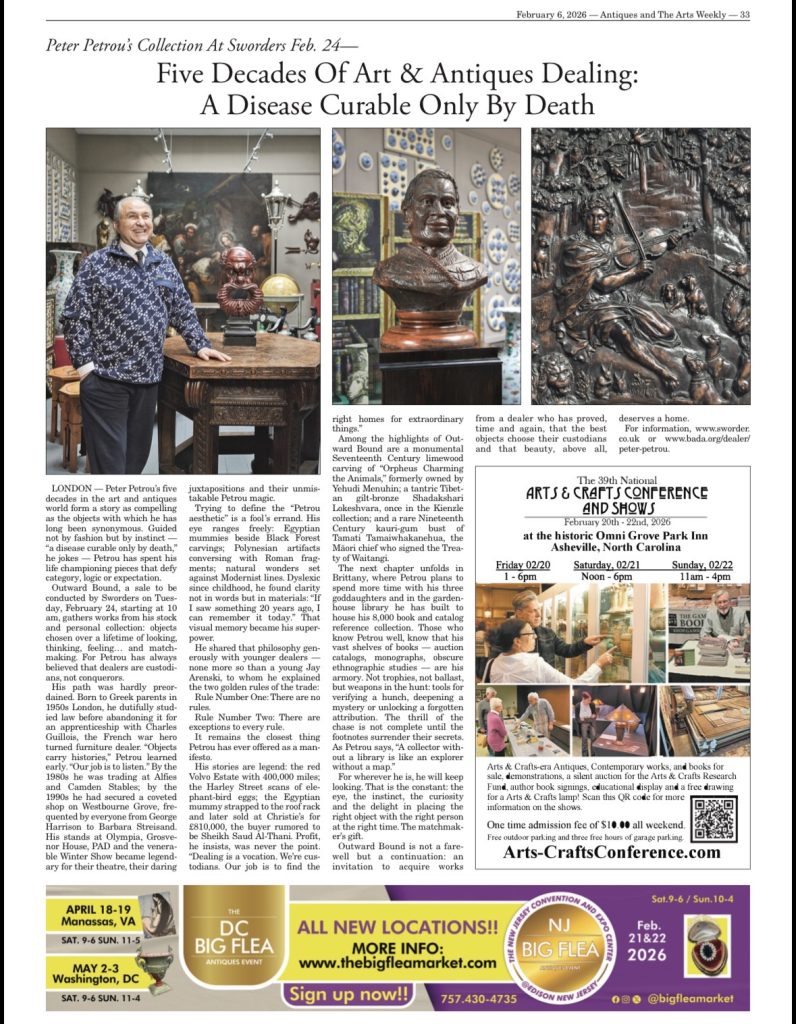
Peter Petrou’s five decades in the art and antiques world form a story as compelling as the objects with which he has long been synonymous. Guided not by fashion but by instinct – “a disease curable only by death,” he jokes – Petrou has spent his life championing pieces that defy category, logic or expectation. Outward Bound, to be held on Tuesday 24 February 2026, gathers works from his stock and personal collection: objects chosen over a lifetime of looking, thinking, feeling… and matchmaking. For Petrou has always believed that dealers are custodians, not conquerors.
His path was hardly preordained. Born to Greek parents in 1950s London, he dutifully studied law before abandoning it for an apprenticeship with Charles Guillois, the French war hero turned furniture dealer. “Objects carry histories,” Petrou learned early. “Our job is to listen.” By the 1980s he was trading at Alfies and Camden Stables; by the 1990s he had secured a coveted shop on Westbourne Grove, frequented by everyone from George Harrison to Barbara Streisand. His stands at Olympia, Grosvenor House, PAD and the venerable The Winter Show became legendary for their theatre, their daring juxtapositions and their unmistakable Petrou magic.
Trying to define the “Petrou aesthetic” is a fool’s errand. His eye ranges freely: Egyptian mummies beside Black Forest carvings; Polynesian artefacts conversing with Roman fragments; natural wonders set against modernist lines. Dyslexic since childhood, he found clarity not in words but in materials: “If I saw something twenty years ago, I can remember it today.” That visual memory became his superpower.
He shared that philosophy generously with younger dealers—none more so than a young Jay Arenski, to whom he explained the two golden rules of the trade:
Rule No. 1: There are no rules.
Rule No. 2: There are exceptions to every rule.
It remains the closest thing Petrou has ever offered as a manifesto.